Monthly Archives

May 2026

A Year After SB 319: Montana’s Doula Care Movement Keeps Moving Forward

By Birth, Caregiving, Doulas and Doula Care

This week marks one year since SB 319 was signed into law in Montana, establishing a path for licensed doulas to be reimbursed through Medicaid. 

It’s been a long journey to align Montana with the 25 other U.S. states that currently cover doula care under their Medicaid programs – and, as we learned this Spring, it isn’t over.

Throughout the 2025 Legislative Session, HMHB-MT worked closely with the Montana Doula Collaborative and other doulas, Indigenous birthworkers and healthcare providers and advocates to advance SB 319. In legislative hearings and meetings with policymakers, these partners consistently emphasized the role of doula support in better health outcomes, including lower rates of birth complications and maternal deaths, higher rates of breastfeeding, and improved maternal mental health. 

While the signing of the bill was a step forward in improving maternal care, a move especially crucial in Montana’s rural and Tribal communities where birthing resources are scarce, progress faltered in late March 2026. Without warning, officials at the Montana Department of Public Health and Human Services told KFF Health News the agency would not be moving forward with implementing Medicaid coverage of doula care due to a budget deficit.

Staff at HMHB-MT joined with Berry Medicine Native Birthwork Initiatives, the Montana Doula Collaborative and other groups that had advocated for SB 319, in reaching out to the Department and legislators. They again reinforced the importance of doula care, pointing out that the bill had received strong bipartisan support because evidence showed that doula care – associated with reductions in cesarean and preterm births, and postpartum anxiety and depression – improved maternal and infant health outcomes while reducing overall healthcare costs. In Montana, about 40% of births are covered by Medicaid – in 2023, this cost the state more than $75 million. Birthing costs for children born prematurely and low birth weight were on average three times higher. Improving these health outcomes, advocates pointed out, reflects a significant cost savings.

A week later, the decision to table the bill was reversed.

“Instead of just taking that as a loss, the doula and birthworker community activated and mobilized, and reached out to our legislators and our leaders,” said State Sen. Cora Neumann, a Democrat who sponsored the bill, in a video on social media. 

“We have to celebrate every win,” Neumann said, following the news. “And this is a big one for Montana families, for mothers, [and] for babies. [Doula care] is playing a huge role and really growing in Indian Country. I just want to say congratulations and continue to remind everyone there is a way to make an impact…”

This week, HMHB-MT, Berry Medicine Native Birthwork Initiatives and the Montana Doula Collaborative submitted joint public comment to the Legislative Finance Committee, noting that while the Department has stated it will be moving forward with implementing a Medicaid benefit for doula care, it has also stated that, “All optional services, including this service, are being reviewed.”

In our collective public comment, we responded it was deeply alarming that a low-cost, cost-saving, workforce-expanding service for pregnant and postpartum women could be in consideration for elimination.

“More than half of Montana’s counties are designated as maternity care deserts and that figure jumps to more than 90% in counties with an American Indian majority,” our comment, co-writtten and signed by HMHB-MT Policy Director Mary Collins, Berry Medicine Native Birthwork Initiatives Executive Director Dr Amy Stiffarm, and Montana Doula Collaborative Board President Sheri Walker, stated in the May 13, 2026 submission to the Committee. “Doula care fills critical gaps in these rural and Tribal communities where maternity providers are scarce, hospitals have closed obstetric units, and families must travel long distances for care.”

Here at HMHB-MT, we are continuing to advocate for and support the implementation of SB 319. In addition to our efforts to advance Medicaid coverage of doula care, HMHB-MT supports doulas in obtaining their license through the Montana Department of Labor and Industry and is hosting a Doula Day on Monday, June 22 in Billings as our 9th annual Perinatal Mental Health Conference begins.

If you’d like to learn more about our work to advance doula care in Montana, please email Mary Collins, Policy Director, at mary@hmhb-mt.org
Navigating a new season this Mother’s Day

By Caregiving, Grief

By Gwyneth Hyndman, HMHB Storytelling Coordinator 

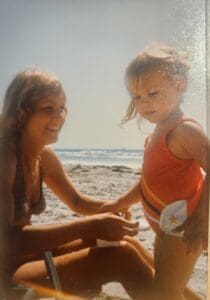
Storytelling coordinator Gwyneth Hyndman, right, with her mother, Judy, in 1980.

For the last six years, I’ve lived in a brief window of being both a daughter and a mom on Mother’s Day.  

I’m in my 40’s, so I’m old enough to know that everything about this time has been rare, unearned, and no matter how long this stretched, it was never going to be enough. 

Three weeks ago this window eased shut and closed forever. 

And of course it wasn’t enough. Enough time, enough stories, enough apologies, enough explanations. In the aftermath, I watched my two daughters play in the waves just north of where my mother used to bring me, preparing for the hours ahead that would lead us east and back to Montana, still feeling the squeeze of Mom’s hand holding mine for the last time. 

Fog burned off above the water that morning, mirroring the haze that had settled in my brain. As we cruised along the San Luis Obispo Bay, Eliza, 5, asked what a port was. I replied absently that it was where boats came back to, to be safe. It struck me that the word I was searching for in the hours after my mother died was “adrift.” I was a boat without a port.

This side trip off Highway 101 to the ocean now felt hollow and pointless without her presence in the world. I took a photo of the girls walking on the Port San Luis Pier and my hand holding the camera dropped: who was I even going to send these photos to? Who would care, as much as my mother cared?

I stared at the sea. No action on earth made sense without my mom here.

Then, my eyes caught movement in the water. 

At first I thought the tide going out was revealing a large, dark stone. Then a chill. This was no stone. Years ago, a woman had been killed by a shark here as she was swimming back from the buoys. Instinctively, I bolted towards the girls, calling and waving for them to come back to shore. 

As I ran, I watched the water, adrenaline surging. Another sleek, swift movement parallel to me. Again something dark and gleaming in the morning sun. I stopped, a hand over my eyes, as I watched the abrupt turn and submersion of the sea lion’s body, before its head reappeared, its dark eyes turned towards me on the shore, moving backward through the water in an easy, effortless, backstroke.

My mother, who had been paralyzed in her left leg since her early 30s, swam this way. It was a series of sidestrokes and backstrokes that allowed her to glide ahead, to change directions, also effortlessly, in a way that she couldn’t move on crutches. I would swim alongside her, mimicking her movements, but the water was her realm of beauty and power. 

In my mother’s last days as we watched the sun go down over the oaks on the hills across the driveway from my childhood room – the easiest place for her hospital bed to be in the house she and my father had lived in for 45 years – we talked about this memory.

“Remember,” I’d say? “All the oceans, lagoons, rivers and pools we swam in?” Even when her eyes were closed, and her speech was gone, I’d see her lips curve into a smile. Mom remembered.

Here, on the shore, I trace the sea lion as it backstrokes away from the girls and I. With one final, elusive movement, it slips back into the depths.

I left the girls behind me, and ran along the packed sand, my eyes searching for any disturbance in the water. If there was even a ripple at that moment, I probably would have dived in after it.

But the sea lion  was gone. I stood there, tears streaming, as the saltwater surged through and around my legs but also laughing, feeling – against all odds – delight and wonder. Later, in the 19 hour drive back to Montana, one of the many, many podcasts on grief I’d find, someone talked about how it’s our right, as the bereaved, to let our minds assign whatever meaning we need to these encounters. It’s my right to be ridiculous.

Grief is feral. It’s powerful. But also unavoidable if we are gifted with a full life. There is nothing to do but to swim through this first year and report back from the other shore, as so many other daughters have done before me, and will do after me. 

My girls’ arms hold on to me in a Nevada swimming pool the next morning, desert palms above us, as we practice floating on our backs. They mimic me as I do sidestrokes and backstrokes and turn in the water, my tears mixing with the chlorine. I know that how I grieve my mother now, will likely be how they will grieve me someday.

I don’t know what this first Mother’s Day will look like without hearing my mom’s voice. The girls want me to stay in bed so they can help make breakfast with my husband and pick dandelions from the back yard. I know I will cry. I will finish the book Mom and I were reading together while lying under layers of blankets. I will call my dad. I will stand in the sun on our back porch and listen to the mourning doves.

And maybe in the afternoon, if there’s time, we’ll go swimming.

Happy Mother’s Day everyone, whatever that looks like for you this year.  May Sunday be the port you need.  One of rest, grace, reflection, heavy blankets, birdsong, forgiveness, strong coffee with real cream, sunlight on your eyelids, and if you need it, an Olympic-sized pool to swim through.