By Gwyneth Hyndman, HMHB Storytelling Coordinator
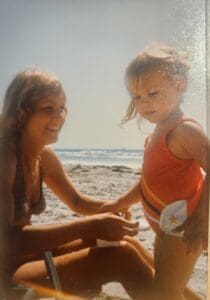
Storytelling coordinator Gwyneth Hyndman, right, with her mother, Judy, in 1980.
For the last six years, I’ve lived in a brief window of being both a daughter and a mom on Mother’s Day.
I’m in my 40’s, so I’m old enough to know that everything about this time has been rare, unearned, and no matter how long this stretched, it was never going to be enough.
Three weeks ago this window eased shut and closed forever.
And of course it wasn’t enough. Enough time, enough stories, enough apologies, enough explanations. In the aftermath, I watched my two daughters play in the waves just north of where my mother used to bring me, preparing for the hours ahead that would lead us east and back to Montana, still feeling the squeeze of Mom’s hand holding mine for the last time.
Fog burned off above the water that morning, mirroring the haze that had settled in my brain. As we cruised along the San Luis Obispo Bay, Eliza, 5, asked what a port was. I replied absently that it was where boats came back to, to be safe. It struck me that the word I was searching for in the hours after my mother died was “adrift.” I was a boat without a port.
This side trip off Highway 101 to the ocean now felt hollow and pointless without her presence in the world. I took a photo of the girls walking on the Port San Luis Pier and my hand holding the camera dropped: who was I even going to send these photos to? Who would care, as much as my mother cared?
I stared at the sea. No action on earth made sense without my mom here.
Then, my eyes caught movement in the water.
At first I thought the tide going out was revealing a large, dark stone. Then a chill. This was no stone. Years ago, a woman had been killed by a shark here as she was swimming back from the buoys. Instinctively, I bolted towards the girls, calling and waving for them to come back to shore.
As I ran, I watched the water, adrenaline surging. Another sleek, swift movement parallel to me. Again something dark and gleaming in the morning sun. I stopped, a hand over my eyes, as I watched the abrupt turn and submersion of the sea lion’s body, before its head reappeared, its dark eyes turned towards me on the shore, moving backward through the water in an easy, effortless, backstroke.
My mother, who had been paralyzed in her left leg since her early 30s, swam this way. It was a series of sidestrokes and backstrokes that allowed her to glide ahead, to change directions, also effortlessly, in a way that she couldn’t move on crutches. I would swim alongside her, mimicking her movements, but the water was her realm of beauty and power.
In my mother’s last days as we watched the sun go down over the oaks on the hills across the driveway from my childhood room – the easiest place for her hospital bed to be in the house she and my father had lived in for 45 years – we talked about this memory.
“Remember,” I’d say? “All the oceans, lagoons, rivers and pools we swam in?” Even when her eyes were closed, and her speech was gone, I’d see her lips curve into a smile. Mom remembered.
Here, on the shore, I trace the sea lion as it backstrokes away from the girls and I. With one final, elusive movement, it slips back into the depths.
I left the girls behind me, and ran along the packed sand, my eyes searching for any disturbance in the water. If there was even a ripple at that moment, I probably would have dived in after it.
But the sea lion was gone. I stood there, tears streaming, as the saltwater surged through and around my legs but also laughing, feeling – against all odds – delight and wonder. Later, in the 19 hour drive back to Montana, one of the many, many podcasts on grief I’d find, someone talked about how it’s our right, as the bereaved, to let our minds assign whatever meaning we need to these encounters. It’s my right to be ridiculous.
Grief is feral. It’s powerful. But also unavoidable if we are gifted with a full life. There is nothing to do but to swim through this first year and report back from the other shore, as so many other daughters have done before me, and will do after me.
My girls’ arms hold on to me in a Nevada swimming pool the next morning, desert palms above us, as we practice floating on our backs. They mimic me as I do sidestrokes and backstrokes and turn in the water, my tears mixing with the chlorine. I know that how I grieve my mother now, will likely be how they will grieve me someday.
I don’t know what this first Mother’s Day will look like without hearing my mom’s voice. The girls want me to stay in bed so they can help make breakfast with my husband and pick dandelions from the back yard. I know I will cry. I will finish the book Mom and I were reading together while lying under layers of blankets. I will call my dad. I will stand in the sun on our back porch and listen to the mourning doves.
And maybe in the afternoon, if there’s time, we’ll go swimming.
Happy Mother’s Day everyone, whatever that looks like for you this year. May Sunday be the port you need. One of rest, grace, reflection, heavy blankets, birdsong, forgiveness, strong coffee with real cream, sunlight on your eyelids, and if you need it, an Olympic-sized pool to swim through.
 I was 22 then, and wouldn’t receive an accurate diagnosis until five years later.
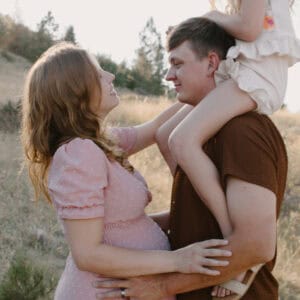 I found out I was pregnant with my second in December of 2023, and told my doctor that I wanted to taper off my medication. I’d done the research, and knew that mine was one of the most recommended mood-stabilizers for pregnancy, but in spite of advocating for the destigmatization of mental-health conditions, I knew deep down that I didn’t want to admit to my new medical team that I was dependent on a medication for survival. My doctor expressed concern, but said it was ultimately my decision. I made the choice to stop.
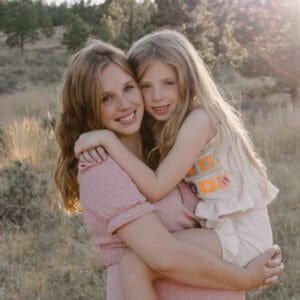 A diagnosis does not define you. It can dictate choices you make, but it doesn’t have to be your entire identity. The imbalances within my body don’t determine my capabilities as a parent. I can be a great mom, a loving wife, and a functioning member of society while also needing assistance in maintaining the disequilibrium in my brain that is quite literally out of my control. What is in my control, however, is choosing to be honest with myself and my support team, so that I can not just survive, but thrive.
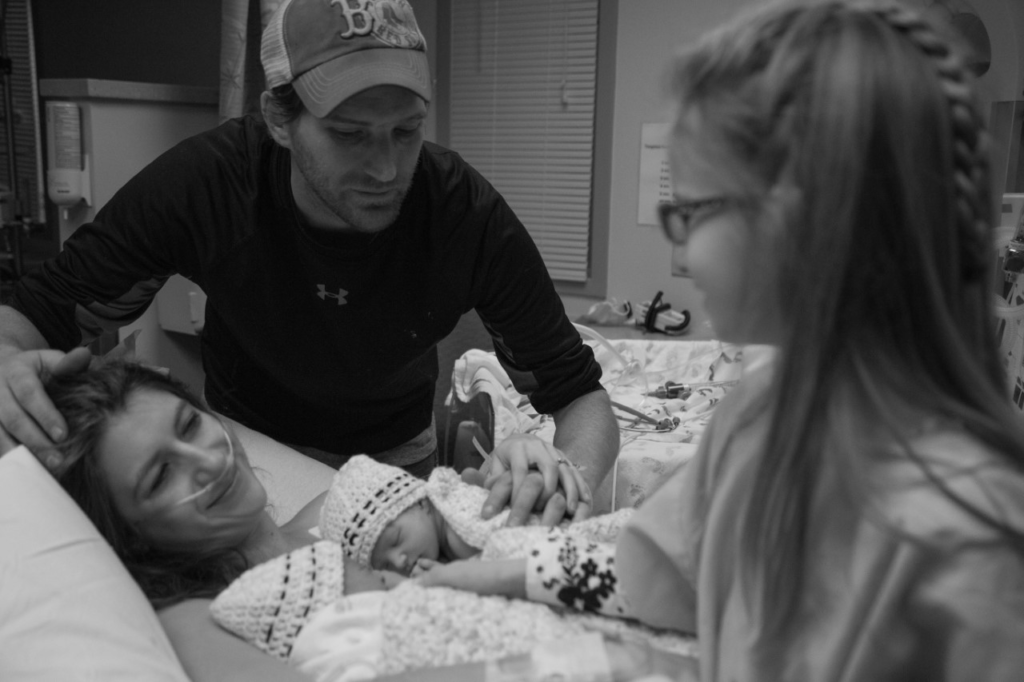
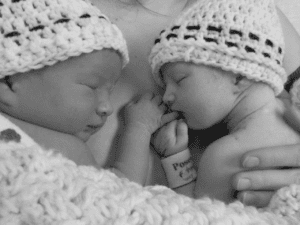 The first year was numb as we maintained survival mode. One lonely twin didn’t want to eat, an older sister didn’t know how to grieve, and two parents mourned in their corners yet still occasionally found each other. I searched for answers and signs of my daughter gone from earth. I had sudden moments of sorrow and angst, remembering not all my children are with me. We celebrated milestones, watched a personality emerge, and witnessed the discoveries of young childhood – all while quietly acknowledging the persistent, sad void that coupled each of those milestones. I found solace when I focused on my mother holding my baby, rocking her, just as if they were with me.
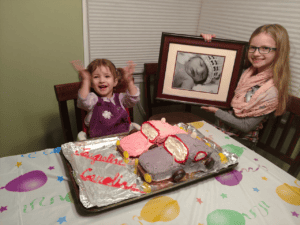 Jacqueline shows up in our lives in many different ways. Amidst a stint of relentless bickering between Olivia and Caroline, we approached the store aisle containing a plethora of various gingerbread house kits. I dreaded yet another argument about which type to purchase as I listed them — Barbie, Mickey Mouse, and so on. Much to my surprise, they immediately agreed on a birdhouse with a red cardinal perched in front. A red cardinal can be a sign of hope from a departed loved one, a sign of their peace. It was as if they knew.
Recent Comments