By Gwyneth Hyndman, HMHB Storytelling Coordinator
I place Hamnet on my knee at page 207 and stare beyond the wing of the Boeing 737 window. My face is wet with tears I wipe away with a sweatshirt sleeve, feeling everything that powerful stories ignite.
Icy peaks of the Gallatin Range and Tobacco Root Mountains rise through the clouds, thousands of feet below as we head south and west towards the Pacific Ocean. I give Maggie O’Farrell’s imagined backstory of Shakespeare’s tragedy a pause so I can pull it together, accept the tissue handed to me from the woman in seat 27 B, and remind myself I’m only gone five days and that traveling alone right now is a luxury.
Instead, the ache to hold my daughters is almost gravitational.
Flying solo with Jessie and Eliza, now 6 and 4, were some of our first bonding moments. I had more than 40 years of travel on my own before I became a mother. After four pregnancy losses, I suspect part of me held back from planning beyond nine months. Both births became C-sections. I was never able to breastfeed successfully. I shook off fumes of failure every time I stood in the checkout line with baby formula at our local grocery store. But flying with each of them at six weeks old to visit my parents in California, watching skies, mountains, oceans, their sea shell earlobes and twitching noses as they slept in my arms, undisturbed by the world below, as the turbulence worked its magic, was like we were finding our footing. Up here, it was safe to fall in love with this new life in my arms, without feeling like I was tempting fate.
O’Farrell’s words were a reminder that this rose-hued season – with all its conveniently forgotten exhaustions, frustrations and nightmare toddler travel tales to come – is behind me now. And if you’ve read Hamnet, or watched the stunning film adaptation as it soars through the 2026 awards season, you’ll be aware that it is a guide through the darkest places a parent can walk.
Hamnet is a reminder that storytelling – both the story, and the telling of it – is illuminating.
In my first few weeks as the Storytelling and Engagement Coordinator for Healthy Mothers, Healthy Babies, I’ve made my way through half a decade of storytelling in Montana. I’ve cried while washing dishes and listening to “EnduringLoss with Emily Tosoni” in the first season of the Mother Love/LIFTS Podcast. I’ve stood in the middle of my office and said “Huh,” out loud to no one in particular, when a statistic hit home in the “Mining City Stories” series of Season 4. I’ve allowed myself to be unsettled and angry while watching Siloed, a documentary on the disparities in maternal healthcare in rural Montana, and more than once, as first-person narratives were shared in the last five years of our LIFTS Magazine, thought: Hey, me too.
Stories don’t just bring us to tears and leave us there. They can move us to take action. They ask that we clarify our purpose and at their best, face and explore our fears.
For those of us reading on our couch during naptime, or listening in our cars, stories can be ports in a household storm, a stolen hour of stability and connection in the chaos and devastation of the world outside.
For the storyteller, the very art is like dumping a purse all over the floor to sort out what’s actually been buried in there. We make decisions on what’s treasure and what’s trash every time we pick up a pen or open our laptop.
What do I hold on to? What can I throw in the garbage to make this handbag a little less heavy? What can I share that might be valuable?
As the team at Healthy Mothers, Healthy Babies sits down to map out our 2026 season of the LIFTS Podcast, and look ahead to the 6th annual issue of our LIFTS Magazine this summer, I’m honored to step into a role that Claire and Emily established and shaped with such respect, trust and tenderness, bringing our rich stories across Montana to the page and podcast.
If you have any thoughts on topics, issues and policies that you believe are important to parents, caregivers and providers in our state, you can reach me at gwyneth@hmhb-mt.org
And as always, we welcome your story submissions at stories@hmhb-mt.org
I’m so thrilled to read and hear your words in the months to come,
Gwyneth
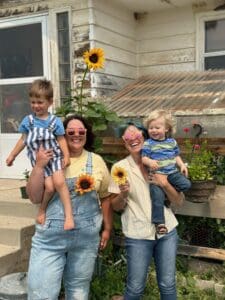
 I eventually got into the drug court program, and went to treatment, and that’s when Callie and her family got involved as foster parents.
 It can be challenging to make friends in your adult life. I can’t count the number of times I’ve tried to connect with people and then they don’t ever call back. I just really crave that community.
 The moms group was an hour’s drive away, and the first time I went I was nervous, but excited to be out of the house by myself, listening to music as loud as I wanted. I felt like I had a grip on a little of me. When you become a mom, you can lose yourself, and it’s all about figuring out how to reinvent.

 “You’re an adult woman, you can do this!” my husband Bob says over the phone from 1,500 miles away, as I dress our four-month-old son, Emmett.
 Walking down the ramp into the building’s basement, I feel nauseous. “We can do this, right buddy?” I ask Emmett.

 I was 22 then, and wouldn’t receive an accurate diagnosis until five years later.
 I found out I was pregnant with my second in December of 2023, and told my doctor that I wanted to taper off my medication. I’d done the research, and knew that mine was one of the most recommended mood-stabilizers for pregnancy, but in spite of advocating for the destigmatization of mental-health conditions, I knew deep down that I didn’t want to admit to my new medical team that I was dependent on a medication for survival. My doctor expressed concern, but said it was ultimately my decision. I made the choice to stop.
 A diagnosis does not define you. It can dictate choices you make, but it doesn’t have to be your entire identity. The imbalances within my body don’t determine my capabilities as a parent. I can be a great mom, a loving wife, and a functioning member of society while also needing assistance in maintaining the disequilibrium in my brain that is quite literally out of my control. What is in my control, however, is choosing to be honest with myself and my support team, so that I can not just survive, but thrive.
 The first year was numb as we maintained survival mode. One lonely twin didn’t want to eat, an older sister didn’t know how to grieve, and two parents mourned in their corners yet still occasionally found each other. I searched for answers and signs of my daughter gone from earth. I had sudden moments of sorrow and angst, remembering not all my children are with me. We celebrated milestones, watched a personality emerge, and witnessed the discoveries of young childhood – all while quietly acknowledging the persistent, sad void that coupled each of those milestones. I found solace when I focused on my mother holding my baby, rocking her, just as if they were with me.
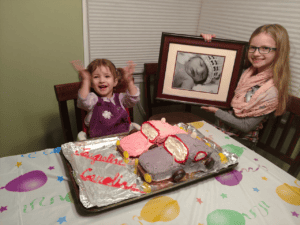 Jacqueline shows up in our lives in many different ways. Amidst a stint of relentless bickering between Olivia and Caroline, we approached the store aisle containing a plethora of various gingerbread house kits. I dreaded yet another argument about which type to purchase as I listed them — Barbie, Mickey Mouse, and so on. Much to my surprise, they immediately agreed on a birdhouse with a red cardinal perched in front. A red cardinal can be a sign of hope from a departed loved one, a sign of their peace. It was as if they knew.
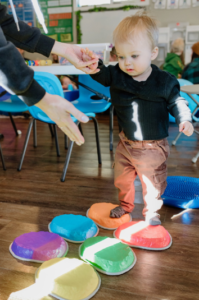 The
The 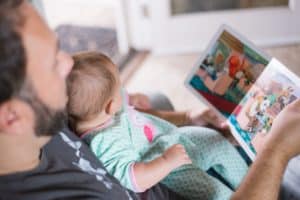
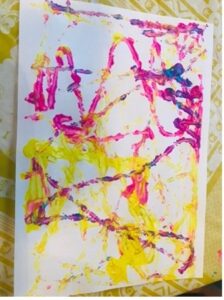
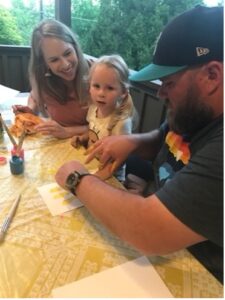
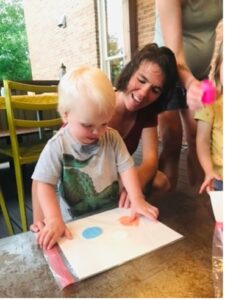 Plastic bag painting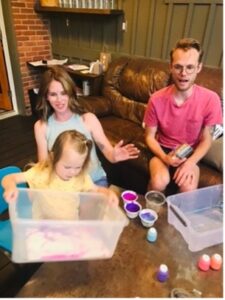
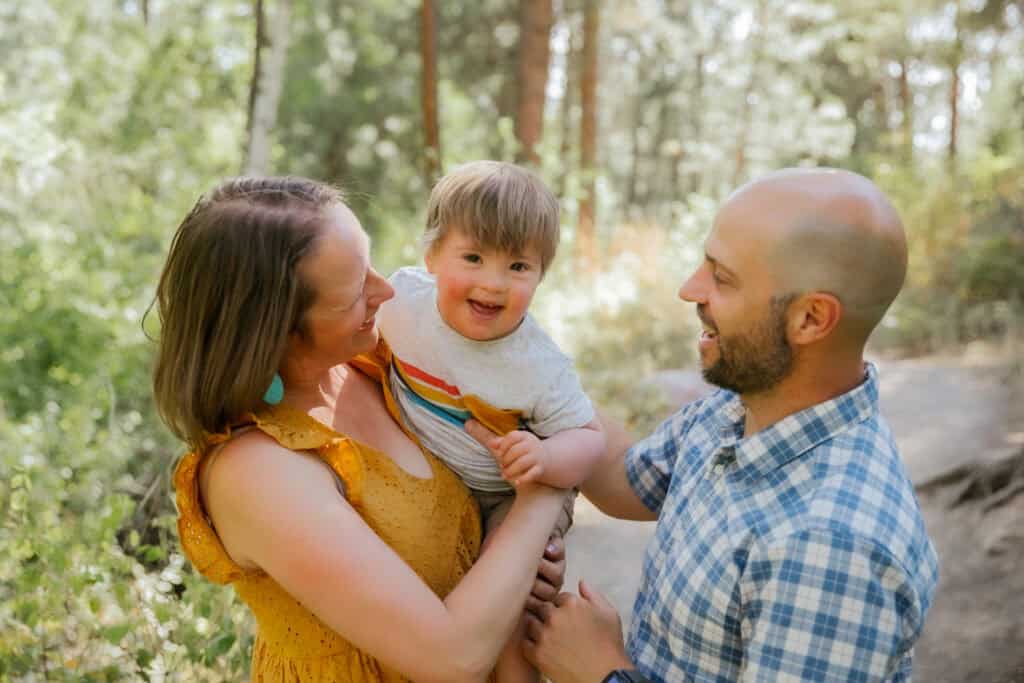
 My feelings were complex during pregnancy, and talking them through with my partner and friends was incredibly important. I often worried that I wouldn’t know how to connect with my son. I leaned into the words I read from other parents, that “once your baby is born it will be fine, he will just be your baby.” Before becoming a mother, I didn’t know that love for your children grows out of thousands of tiny moments of nurturing, not because your baby shows up in a certain way. And when Alex was born, I could see the depth in his sparkly little eyes and knew I didn’t need to worry about connecting. I’m saddened now that I didn’t understand this before. People with Down syndrome are just people, and being able to connect really isn’t surprising.
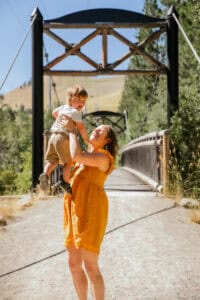 When looking into preschools, we were referred to someone at our local Child Care Resource and Referral office who equipped us with information on reasonable accommodations and a list of questions to ask when we visited different programs. This helped us self-advocate and, ultimately, we chose a program that was open to adaptations and that valued my family as collaborators in Alex’s education.
Recent Comments